EN
EN


How to Request a Quote for Commercial Bounce Houses
For a rental operator, distributor, or event-equipment buyer, a useful quote is more than a unit price. A well-prepared request helps suppliers understand the job, reduces back-and-forth, and makes it easier to compare commercial party rental inflatables on the same basis. The goal is to receive a quote that identifies the product configuration, included equipment, delivery terms, lead time, and documentation—not just a headline figure.
This guide explains what to prepare before contacting suppliers, what to put in your RFQ, and how to evaluate responses for a commercial bounce-house purchase. It is written for buyers building or refreshing a rental fleet, planning events, or sourcing for resale.
Start with the operating scenario, not the catalog photo
Begin your RFQ by explaining where and how the inflatable will be used. Commercial party rental inflatables can be deployed at birthday parties, school events, indoor play centers, community festivals, or mobile rental operations. Each setting changes the practical requirements for size, throughput, setup time, power access, transport, cleaning, and storage.
Include the expected user group, age range, venue type, and whether the unit will be rented repeatedly. Tell the supplier if you need a compact unit for indoor venues, a combo design for varied events, or a model intended for high-frequency outdoor rental. This context lets the supplier recommend a configuration instead of quoting a generic commercial bounce house that may not fit your operation.
- Usage setting: indoor, outdoor, covered venue, or mixed use
- Typical users: children, adults, or mixed-age events
- Expected event frequency and rental cycle
- Available setup footprint and height limits
- Local climate, ground conditions, and access constraints
Define the product specification clearly
A request for “a bounce house” is usually too broad for commercial sourcing. State the style you need—standard bouncer, combo bouncer, slide combo, obstacle unit, or themed design—and give target dimensions in the measurement system you use. If dimensions are flexible, specify the maximum footprint and height instead. Also list the quantity per design and whether you want multiple colorways or themes.
For example, a buyer who needs a combo unit can ask a supplier to quote a model comparable in category to this customized inflatable bouncer combo for rental and family use, while still requesting confirmed dimensions, included components, and a final specification sheet. The product-page link gives a shared reference point; the written RFQ should still define the buyer’s own requirements.
Ask suppliers to state the material specification, joining method, reinforcement areas, netting, zippers, anchor points, and repair-kit contents in their quotation. Do not assume that two commercial party rental inflatables with a similar appearance have the same construction scope. A written breakdown is more useful than marketing labels alone.
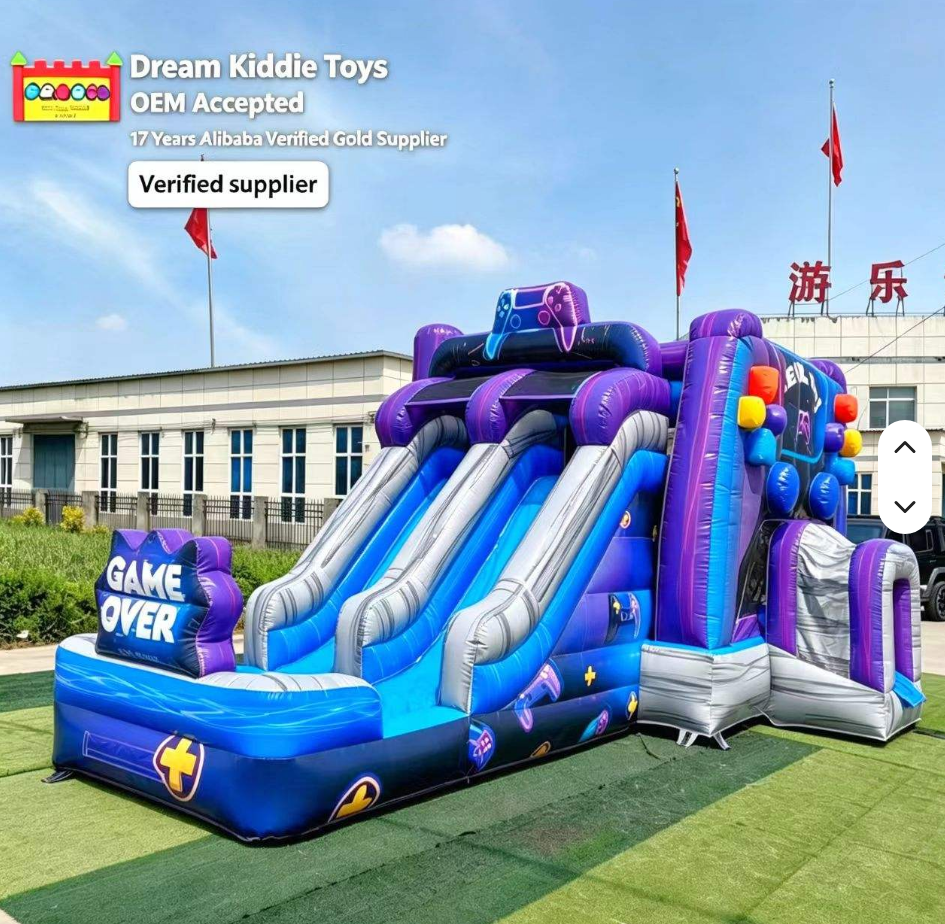
A commercial inflatable configuration should be specified around the intended rental workflow.
Ask for blower, electrical, and accessory details
The blower and accessories affect how a commercial bounce house works in the field. Request the blower quantity, rated power, voltage, plug type, airflow or compatibility information, and whether it is included in the quoted price. A common guide notes that standard bounce-house blowers may require roughly 1,000 to 1,500 watts, while commercial applications may require more; treat this as a prompt to verify the actual configuration rather than a universal rule.
Your RFQ should also list the accessories you expect. Depending on the product and destination, these may include anchor stakes or other anchoring equipment, sandbags where appropriate, a storage bag, repair materials, an instruction manual, and packing information. Ask the supplier to separate included items from optional upgrades so you can compare quote scope accurately.
Include safety and documentation questions
Commercial buyers should request practical safety and operating information early. ASTM F2374-22 describes criteria spanning the design, manufacture, installation, operation, maintenance, inspection, training, auditing, and major modification of inflatable amusement devices. Requirements vary by destination and application, so ask what documents, operating instructions, anchoring guidance, inspection records, or test information the supplier can provide for your target market. Do not describe a product as certified unless the supplier provides the relevant evidence.
Useful RFQ questions include:
- What setup, anchoring, inspection, and maintenance instructions are supplied?
- Which documents are available for the destination market?
- What are the stated user, supervision, and weather-use limitations?
- How should the unit be cleaned, dried, repaired, and stored between rentals?
State quantity, customization, and branding needs
Commercial party rental inflatables are often purchased as a small fleet rather than a one-off item. State the quantity for each design and whether repeat orders are likely. If you need custom colors, printed branding, a themed shape, labels, or packaging changes, provide artwork files and describe the placement. Ask whether a digital layout, sample approval, or production confirmation is part of the process.
For distributors and rental companies, it is helpful to request both a customized quote and a non-customized alternative. This shows the price effect of branding and design changes, helps with internal budgeting, and may shorten the lead time for urgent inventory.
Give a complete delivery and commercial brief
A quote for commercial party rental inflatables should identify the delivery destination and trade terms. Provide the destination country, city or port, postal code when available, and whether you need sea, air, rail, or courier options. Ask for carton or package dimensions, gross weight, and the number of packages so you can estimate warehousing, handling, and freight.
| RFQ item | Why it matters |
|---|---|
| Destination and requested trade term | Allows a comparable freight and delivery quote. |
| Product quantity and target delivery date | Helps confirm production capacity and lead time. |
| Unit price and optional-item pricing | Prevents accessories or customization from being hidden in the total. |
| Payment schedule and quote validity | Supports internal approval and cash-flow planning. |
| Packaging dimensions and gross weight | Supports shipping, storage, and unloading planning. |
Compare quotes on scope, not price alone
Once responses arrive, build a comparison sheet. Put the requested specification in the first column, then record each supplier’s answer exactly as quoted. Check whether every supplier has priced the same design, quantity, blower configuration, accessories, customization, packaging, shipping term, and lead time. If a response is incomplete, send a concise follow-up rather than guessing what is included.
For a decision-stage purchase, the strongest quotation is usually the one that makes the deliverable clear and leaves the fewest operational questions unanswered. A lower price can be meaningful only when the construction scope, accessory list, delivery basis, and documentation are equally clear.
A copy-and-send RFQ checklist
Before sending your inquiry, confirm that it includes: your intended use; product type; dimensions or limits; user group; quantity; material and construction questions; blower and electrical requirements; accessories; safety and operating documentation questions; branding needs; destination; requested trade term; target delivery date; and a request for itemized pricing. This level of detail gives suppliers a practical brief and helps you source commercial party rental inflatables with fewer revisions.
Clear information at the quotation stage helps both sides: buyers can compare offers fairly, while suppliers can recommend a suitable commercial bounce house configuration and prepare a quote that matches the actual project.