EN
EN


Commercial Bounce House Supplier Questions: A Buyer FAQ
Buying a commercial bounce house is not just a matter of choosing a theme and approving a price. Rental companies, distributors, event planners, and wholesale buyers need a repeatable way to compare suppliers before a deposit is paid. The useful questions are the ones that turn a broad quotation into details you can verify: what will be built, what will be packed, what documents will travel with the order, and who answers when something needs clarification.
As an inflatable-equipment selection advisor would put it, start with your operating setting and customer mix. A school event, a rental fleet, and a reseller catalog can all need a commercial bounce house, but they may need different sizes, artwork approvals, accessory lists, and delivery plans. This buyer FAQ focuses on the questions worth asking a supplier before production begins.
What should I ask about the commercial bounce house itself?
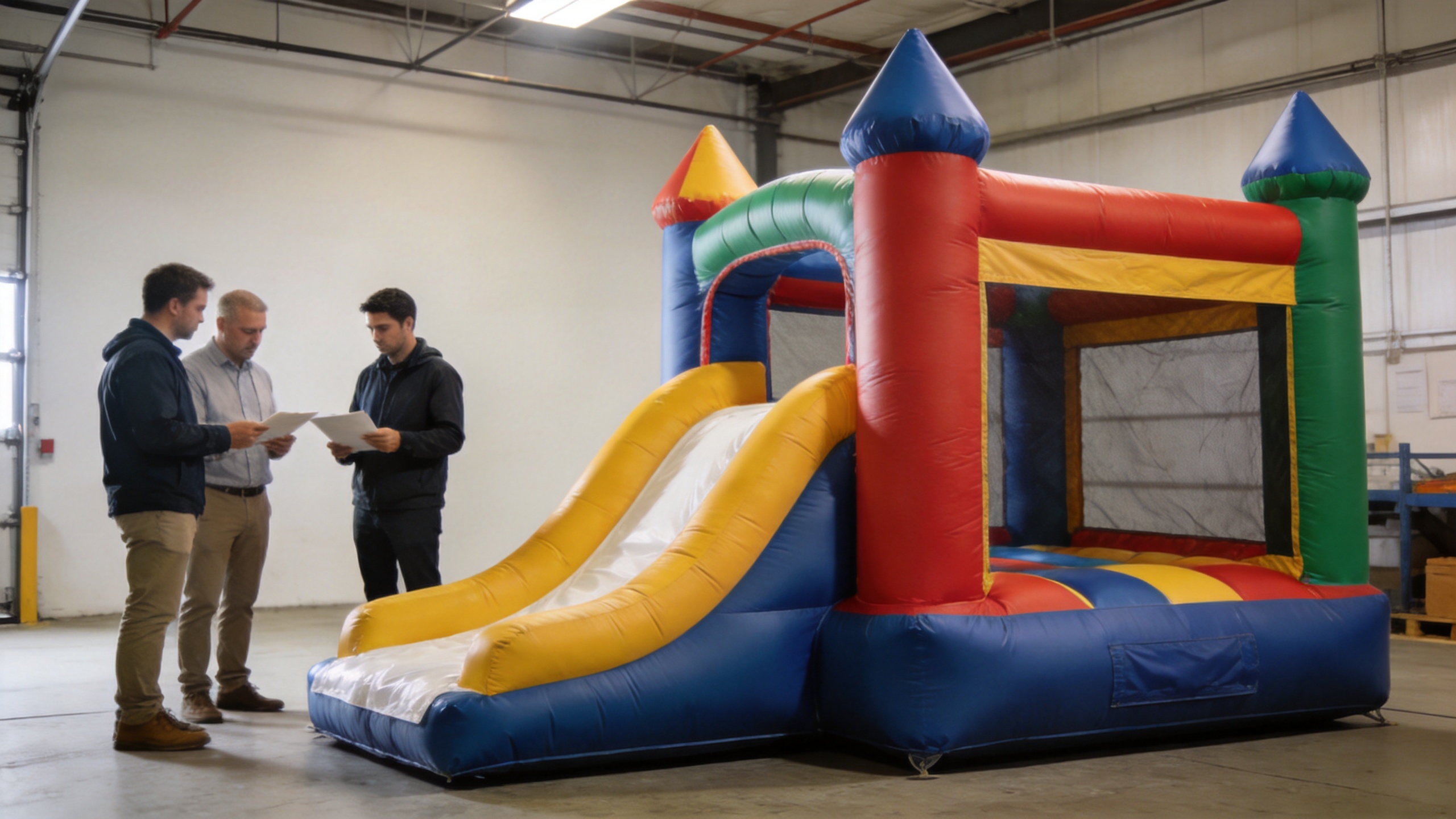
Begin with the model definition. Ask for the finished dimensions, the intended user group, the recommended capacity guidance, the included accessories, and clear photos or drawings of the exact configuration being quoted. If you are comparing a commercial bounce house with a bounce house and slide combo, ask the supplier to separate the play areas and accessories in the quote rather than describing them only as a product family.
- What are the finished length, width, height, and packed dimensions?
- Which blower model, voltage option, plugs, and quantity are included?
- Which anchoring points, repair materials, storage bag, and user instructions are included?
- Can the supplier identify which details are standard and which are custom?
These questions are not a substitute for local safety requirements. They help you see whether two commercial bounce house quotations actually cover the same configuration.
How do I discuss materials, construction, and safety documentation?
Ask suppliers to describe the material specification, seams, netting, anchor points, inflation arrangement, and warning labels in a way your team can compare. Avoid accepting phrases such as “heavy duty” without asking what that phrase means for the quoted unit. A dependable supplier should be able to explain what is included in the product specification and what needs to be confirmed for your destination market.
For a commercial bounce house used in a regulated or professional setting, ask which documents can be supplied and whether they apply to the exact model, blower, and market. Search results mention standards such as ASTM F2374-22 and NFPA 701, but applicability depends on the product and destination. Treat standard names as prompts for verification, not as proof that every unit is certified. Your importer, insurer, local authority, or event operator may have additional requirements.
Can the supplier handle customization without creating production confusion?
Customization can be valuable for rental brands, distributors, and event programs, but it needs a written approval path. Ask for artwork templates, logo placement areas, color references, revision limits, and a final proof that identifies the exact commercial bounce house being produced. Clarify whether changes to a bounce house and slide layout affect dimensions, accessories, lead time, or packaging.
A practical rule is to separate commercial approval from creative discussion. Keep the final product name, artwork file version, color notes, accessory list, and shipping marks together in one approval record. That reduces the chance that a familiar sample image is mistaken for your final custom build.
What should be confirmed about packaging and shipping?
For international purchasing, packaging questions are procurement questions. Ask how each commercial bounce house will be folded, bagged, labeled, and protected; request packed weight and carton or bag dimensions for freight planning. Confirm whether blowers, repair kits, paperwork, and spare parts are packed with the unit or separately.
| Question | Why it matters |
|---|---|
| What are the packed dimensions and gross weight? | Supports freight quotes and warehouse planning. |
| What shipping marks will be used? | Helps match cartons or bags to the purchase order. |
| Which documents are included? | Helps your team prepare receiving and compliance checks. |
| Can photos be shared before dispatch? | Creates a final record of the packed order. |
Ask the supplier to state the trade terms, port or delivery point, production lead time, and what triggers the lead-time clock. The most useful answer identifies assumptions rather than promising an unconditional date.
How should I evaluate communication and after-sales support?
Before placing a larger order, test the supplier’s communication with a small set of specific questions. Do they answer the configuration questions directly? Do they distinguish confirmed facts from items that still need approval? Can they provide a clear packing list and explain how replacement parts or repair guidance are handled?
For buyers exploring themed units, this commercial inflatable shark bounce house combo is an example of a product page you can use to discuss a defined model with a supplier. The link is useful for product identification; confirm all configuration, documentation, and delivery details in your own quotation.
What is the final commercial bounce house supplier checklist?
- Match the quoted model, dimensions, accessories, and blower arrangement to your operating plan.
- Ask for written clarification of materials, construction details, labels, and documents relevant to your market.
- Approve custom artwork and product details through a version-controlled record.
- Confirm packed dimensions, weights, shipping marks, delivery terms, and pre-dispatch photos.
- Agree on communication contacts, inspection points, and the process for parts or repair questions.
A good commercial bounce house supplier conversation is specific, documented, and tied to the unit you are buying. Rather than looking for a single preferred supplier, use the same questions to compare fit for your product range, customers, destination market, and delivery process. That approach makes it easier to buy a commercial bounce house or a bounce house and slide configuration with fewer avoidable surprises.